
Lab Notes
Stuff I’m thinking about that have something to do with writing and creating.
Interesting preprint paper comparing human writing to AI-generated writing
A new paper by Jenna Russell, Rishanth Rajendhran, Chau Minh Pham, Mohit Iyyer, John Wieting from the University of Maryland and Google DeepMind dropped. They analysed over 60 000 stories written by both humans and AIs. A ginormous sample.
In the paper, AI stories were detected as being more direct and clear. This ended up in flat storylines, clean narratives, and explicit morals.
Human authors have been shown to write implicitly, allowing their texts to be understood in different ways or using their texts as vehicles for researching or expanding the writing prompts, not handing meaning over to the reader.
More importantly, human authors show greater diversity.
The differences are not found just in the writing styles used (from my experience, humans that write clearly get unfairly flagged as using AI), but the narrative structures beneath the surface styles as well.
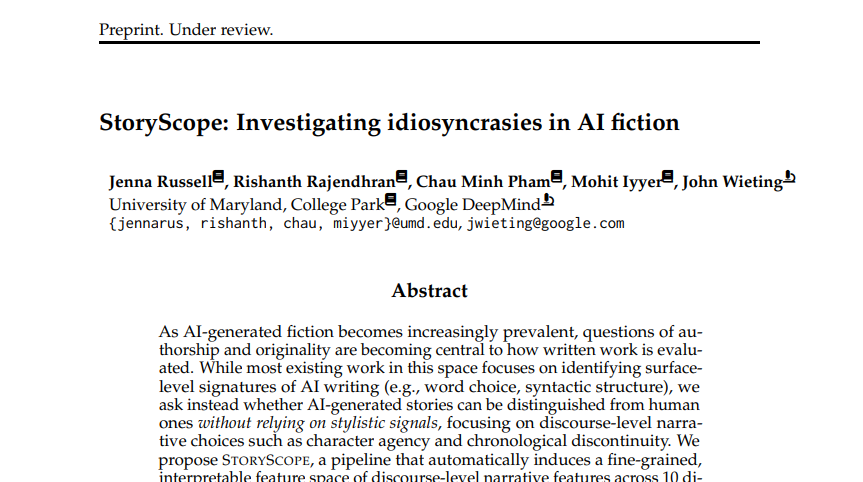
StoryScope: Investigating idiosyncrasies in AI fiction paper from arXiv
My take
This analysis speaks to the importance of the human experience in writing and the use of subtext in fiction. Machines treat text as statistics, that’s how they predict output. That’s not how you write emotionally impactful stories. You don’t get to math your way into linguistic mastery.
As a reader, I want to read stories that challenge me. I want messy streams of consciousness, original voices, and none of those things can be mimicked. If it’s not there, there’s no amount of machine play-pretend that can come close. Writing fiction is not what machine learning is best used for anyway.
Your brain on knowledge
I’m researching about expertise to improve my own logical and reasoning skills. That’s how I found this paper on how the brain changes while learning:
Hill NM, Schneider W. Brain Changes in the Development of Expertise: Neuroanatomical and Neurophysiological Evidence about Skill-Based Adaptations. In: Ericsson KA, Charness N, Feltovich PJ, Hoffman RR, eds. The Cambridge Handbook of Expertise and Expert Performance. Cambridge Handbooks in Psychology. Cambridge University Press; 2006:653-682.
And that’s how I picked up this marvelous brain scan that shows you the difference between how hard a beginner has to work to learn something new and how effortlessly a master practices their craft, from the same paper:
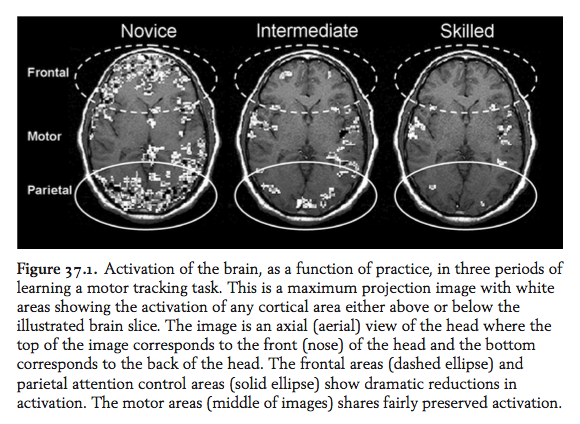
Naturally, beginners are at capacity, or easily overwhelmed. This is what interface writers and designers know all too well – how hard it is for people to experience something new. The reason why you have to design an experience.
And the experts? They’re not overloaded. They have the breadth and space to think strategically while they pull up their know-how.
Remember this comparison. In a real-world setting, this is the difference between dabbling and making an educated guess that wins against what everyone else thinks is going to happen.
Read the full paper:
The thinking machine
For me, there’s nothing more exciting than spending time in quiet thought. Hear me out. I know it’s not on par with paragliding.
If you ever read a crime novel dying to find out who did it or watched a film that kept you glued to the screen, you’ll know the feeling I’m talking about. It’s that natural desire to find out what happened, to explore unknowns, to know what goes bump in the night. It’s at the basis of storytelling, it’s the hook or the inciting incident that gets you interested in something.
Sometimes, it looks like something that catches your attention while passing under everyone else’s radar.
‘Thinking’ might include:
Entertaining inarticulate thoughts you just can’t seem to push aside
Daydreaming
Finding relevant articles
Making notes out of what I noticed (this also reinforces memory, especially if the notes are handwritten)
Taking a different point of view
Going back and forth
Making new connections
Learning from available case studies
Testing out concepts
Digging through academic sources
Making hypotheses
Making projections
Being aware of what I know
Being painfully aware of what I don’t know
It’s very similar to what we think ancient Greek philosophers were doing when they were trying to make sense of the physical and the metaphysical world. Only you don’t get to have philosophical discussions on the streets anymore. Today, you have to get a job and go to work for that.
The best thinking machine today isn’t a calculator or an AI computer. It’s your own mind.
The common thread to producing great work, whether it’s an oil painting, a philosophical thesis, or a piece of code is the thinking that needs to be invested for the work to get made. Whenever I see people trying to skip the thinking part, which is the hard part (naturally, because using your brain makes you tired), it doesn’t end well, ever. The road to hell is paved in shortcuts.
Humans are natural thinkers, it’s what helped our ancestors survive and got us to where we are today. Maybe you’ll get an adrenaline rush when you jump out of a plane, but you’ll also get a dopamine reward when you get to the bottom of something you pursued because of your natural-born curiosity.

Transferable skills
Way back when, I used to train dance and performance semi-professionally. Anyone who meets me today would never guess, but when I would take a pilates or martial arts class, I would be arguably better than an average person of the same experience level.
Why? Because I already had coordination skills and knew precisely where my body was in space in relation to other bodies in that same space.
Fast forward a couple of years later, in the trenches of being a freelance writer. When I would apply to some gigs, sometimes I’d get a rejection saying I’m not the right kind of a writer. They were looking for a particular kind of specialization, and I wasn’t it, or they just didn’t see that I was, in fact, “it”.
Now specializations are a thing. But they are a thing that has something to do with knowledge. And knowledge, friends, is something attainable, especially when you know what you’re doing and where you need to look.
Today, I don’t perform modern dance on a stage anymore and I’m sure my knees would say thanks if they could. Instead, I started to work in marketing and events, then on computer games, and then on software products, all in the capacity of, basically, a writer.
How did I manage all those quick leaps? And how did I learn stuff in marketing that helped me be a narrative designer and how did narrative design help me be a UX writer… not to mention how useful screenwriting ended up to be when there’s a sudden need to produce a video, but make it very fast.
Here’s the thing. When I learn something new, I spend a lot of time on a single skill and that’s expensive because it’s time you never get back. It better be worth it, right? So I never learn something that I can’t apply to many other aspects of my work. Wherever I look, I look for connections. Here cometh the lesson:

Context to a writer is what physical space is to a dancer. As in recognizing what’s the situation and what it needs from you. It’s the key that unlocks your brain.
A lot of people like to work on repeat and think others do too, that’s what’s good with specializations. But specialists are not that safe of a bet. You need to be on the lookout for people who know what to do when they see something new. This is what it means to have a transferable skill.

How to make a game or movie trailer
Learn how to write and direct a trailer that will both inform and entrance audiences.
A lot of trailers will suffer from one of these afflictions:
it will tell you the whole story up front, spoilers included, instead of getting you interested to find out more
no pace, very flat, no tension, nothing really happens
pretending to be what it isn’t (for example, Joker: Folie À Deux where you feel like you’re watching something very different from what the trailer and the marketing promised – and it is reflected in how the audiences reacted to the movie and the reviews from cinema-goers).
A good trailer can…
drive interest for viewers and players to consume the work, with enthusiasm and social praise.
It can present the work to big festivals, judges, and investors.
It’s a promise to an audience, it’s a way to define what to expect, and this can affect how good the end product will be considered.
But, what makes a trailer good? Better yet, how should you make a trailer if you’re not an editor or can’t hire one before you raise more money?
Me, I will always look at the underlying structure and that’s how I’ll start to work on one. To get quality down, you need a vision with a super solid structure first, and surface-level work second.
This is what I mean, in as few steps as possible.
List all interesting, memorable, or exciting moments that don’t uncover the whole story or spoil anything when taken out of context. This is all the material you have to work with. Use a folder on your computer, a list in a notes app, or cardboard cards to do this.
Rearrange your material from less intensive to more intensive.
Decide on the pace in advance, and that pace will depend on what kind of a project you’re working on, what’s the theme and genre. Pace is rhythm, how fast and how intense things happen, if they go from 0 to 10 or from 2 to 5 before they go back down to 2 and then to 8 and 10 before they drop again. If your thing is a slow burn gothic drama, of course you’re going to reflect that in the trailer by picking the proper rhythm.
The first moment is always an intro to the ordinary, everyday world in the context of your game or movie. Although it’s something ordinary for your characters, it’s going to be out of the ordinary for your audiences, have those two perspectives in mind.
After that, you want to show when something happens that changes everything and it’s this wild ride you’re promising to the viewer.
Continue riding that wave by intensifying the pressure, the mystery, the core theme behind everything. Make sure that you’re posing a question you will only partially answer by the end of the trailer. Leave room for mystery, always.
Think about these steps by watching the trailer for Stranger Things. Pay special attention to the amount of withheld information.
Watch:
Season 1 dropped out of nowhere, audiences had no knowledge about the world or characters.
Season 5 is working with an established fanbase so the newest trailer will be able to use that as leverage. Meaning, having less worldbuilding info to communicate and focus on the action and vibes a lot more, we’ll see what happens when Netflix decides to drop it.

Worry ruins the work
How to stand your ground against doubt in the writing process.
Have you ever worked on something for a while, thinking it’s good progress, just to start asking too many questions at the wrong times?
Writing on your own
Using those questions to make changes you didn’t really think are in character with what you had planned at the beginning. Bit by bit … until the work stopped raising doubts about how it would appear in the public’s eye, but it didn’t feel good anymore.
That’s called overthinking and it’s a trap.
Asking the wrong type of question too early, questions fueled by emotional shortcomings and hidden fears, before the work had a chance to stand on its own legs, is a recipe for disaster in any line of work.
I’ve seen the same thing come up both in creative writing groups and in corporate settings where people may think they are above the pitfalls non-professional enthusiasts fall in. On the contrary, the dynamics of self-doubt affect humans pretty much everywhere. We’re all susceptible.
The secret of working with or in spite of doubt is to treat it no different than drinking a cup of coffee. You need to feel comfortable in dealing with the unknown. Working on anything, the next big American novel, a triple A game, a productivity app, it all involves a lot of unknowns.
The unknown is your best friend.
It feels counterintuitive, but the right thing to do here is to stay calm and not let panic control your actions. You let that energy of the unknown wash all over you, give you ideas, present bumps on the road. The thing with energy is it never goes away, it shifts from one form to another. So instead of panicking, being afraid, or worse, throwing things away, you keep riding that wave, using the energy to produce something of actual worth.
Debilitating doubt is a symptom of not being in control of the self. It feels like fuzz in the mind. Like an unknown entity telling you what to think, what to do. That’s your internal critic.
By all means, do not ignore it. Voice the worry you have, to get it outside of yourself. To take power away from it. But don’t let it take control of the work.
You’re always the one who’s in control.
Working in a group
Especially, be careful in group settings. To a group, voicing concern can behave like wildfire. A virus that takes over every member of a group through a set of social conventions and the cavemen instinct of needing to mimic belonging.
When it comes to other people, the worst type of critic is a vocal, confident one, without experience of their own or a single argument to stand on. You need to learn to shut voices like that down. Whether that means ignoring them completely, or opposing them with your own confidence backed up by actual experience.
I’ve always thought about reviewing, criticism, and groupthink like this:
You can talk anything down as a bad idea. And if not everyone is aware of that, bad things will happen.
A lot of good ideas die very early on as a result of self-doubt or groupthink.
When the group gets tired of talking everything they see down, suddenly the first other thing that gets shown ends up being “good enough.” Why? Nobody minds it.
It doesn’t make people uncomfortable. It doesn’t create impressions or reactions. Usually that’s a symptom of being mid-ground, something everybody can say it’s okay, but it’s not great or the best or the worst.
What’s the worst thing that can happen?
Something you publish ends up being not good enough. So what? Most things are.
Did it still produce a good result? Did you learn something from the experience? Did it lead to a new opportunity?

Aurora borealis by NOAA from their photo library, here to symbolize the unknown.

The unexpected danger of a dialog confirmation
Of all the interface components I’ve worked with, dialogs are the most intimidating. They might look like a simple box, but they are hard to get right.
For the uninitiated, dialogs are UI components meant to make sure users mean to do what the system thinks they want to do. It’s a layer of confirmation. You can use them to collect inputs as well. See this example from Balzamiq:
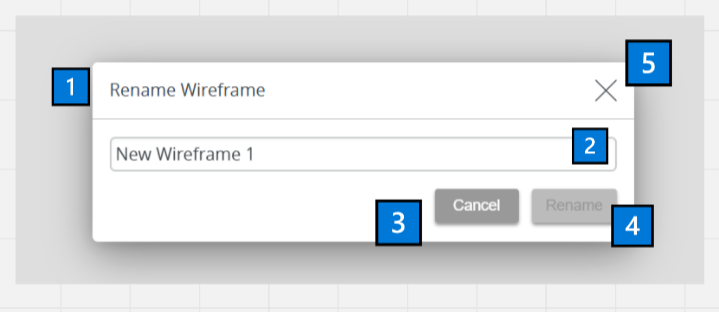
Dialog screenshot from Balzamiq. Action is renaming wireframe.
What a dialog is made of:
Title
Some content or more components/inputs.
Secondary button. This one’s the “I made a mistake, please go away,” command.
Primary button. This one will confirm the action you started with. You’re basically agreeing to something that you set in motion. “Yeah, I really want to do this. Let’s take that red pill.”
Close button. Another way to make the dialog go away if you feel uncertain about what the buttons actually do.
Now that you’ve had the crash course, I’m curious to see what you think about a dialog I encountered in the wild…
I’ve started to play Civilization VI for the first time. Naturally, I don’t know the law of the land. So when I try to move my unit into a strangely colored field, I trip up over this:
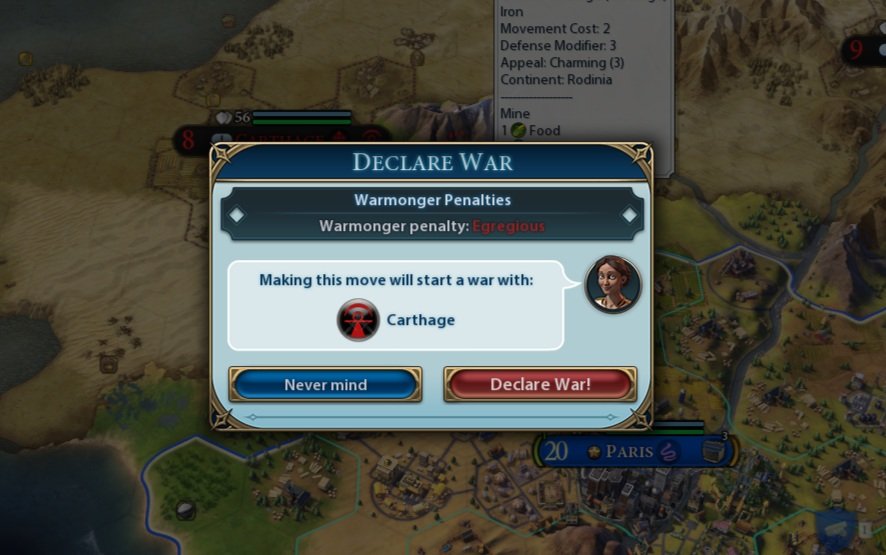
Screenshot from Civilization VI
Umm, what now?
I knew I didn’t want to declare war, but I was confused as to what to do next. What I wanted to do was cancel. My thinking was:
Blue button reads: “Never mind, I can start the war”
Don’t want to start a war by accident.
I couldn’t rely on button position as different systems place secondary and primary buttons in a different spot.
I could not exit the dialog without making the choice (no close button).
Is the question asked about declaring a war or about making a move?
Relying on colors was tricky. Due to my work in UX I read red as danger.
Is the red button here really dangerous or is it just, you know… the color of war?
Basically I was overthinking it. That just shows you how easy it is for a dialog to surprise you.
Holding my breath, I clicked the “Never mind” button and it behaved like a normal “Cancel”. What a relief.
To improve the dialog, I’d use “Cancel” for the secondary button in this particular case. Another option would be to add context (maybe “Cancel the move”). That would feel safe.
I love creative button labels, especially in games. Definitely wrote a lot of those myself. But there is more leeway to be creative with button labels when you’re writing a game where choice is a dialog mechanic (visual novels, RPGs…) or in general UI when only a single button is displayed so nothing is left unclear, there’s no actual choice to make.
Anyways, the game is awesome, I’m really enjoying it. I've established a religion called The Church of the Witch so you know I’m having fun battling the Spanish Inquisition.

Thinking of using all caps or uppercase formatting in a title? Read this first.
A small use case breakdown about using uppercase versus sentence case on an example of two finance apps.
Usually the discussions I’ve been in focus on title case versus sentence case, so having uppercase in the mix is new to me, but this other day I was shopping and my finance app blasted me with an uppercase title.
I was horrified.
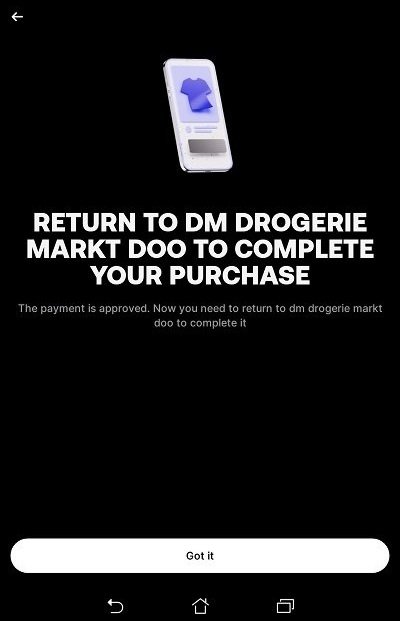
Payment confirmation screen from Revolut
I’m kinda bothered by this. One reason is, this is harder to read and/or slower to comprehend. See for yourself:

Side by side comparison of the different cases
Second reason. When I first saw this, I thought I was on Wise. I literally felt like I’ve closed one app and opened another.
Can you tell why?
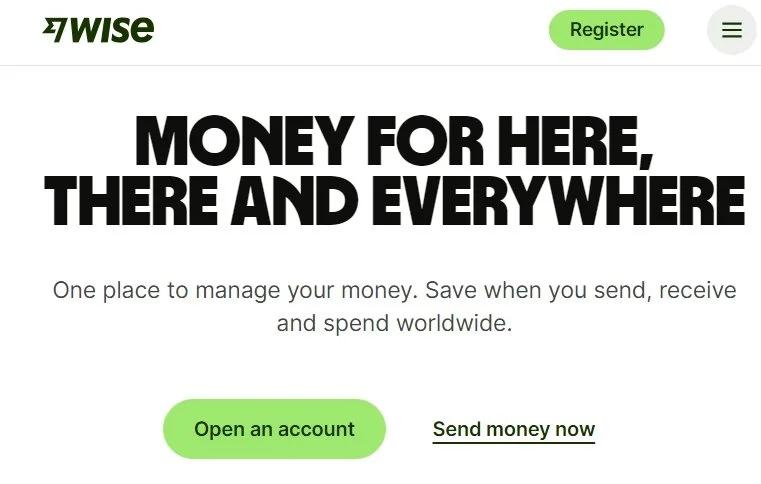
Wise.com webpage
Even if Wise is using a big bold heading at the beginning of their website, it feels like making an impression rather than yelling, especially due to keeping the word count sane and complimenting the experience with a calming white and green color scheme. As a user, I’m not in a payment flow, I’m browsing around and have the time to focus here.
And the moment you travel down the page, the headings switch to the more easy to read sentence case:

Wise.com webpage
Wise has made a decision to be bold, but mindful of where, when, and why, while protecting their readability. Can you imagine if someone decided to just match the main heading and put everything in all caps?
The lesson here?
An uppercase title can work very well for your brand if you know how to use it and why. If you’re just copying something you think will become a new standard, it’s better to play it safe until you get a better idea of what you want to do.